

Member data analysis and tagging
Lots of members, but can you say who they are?
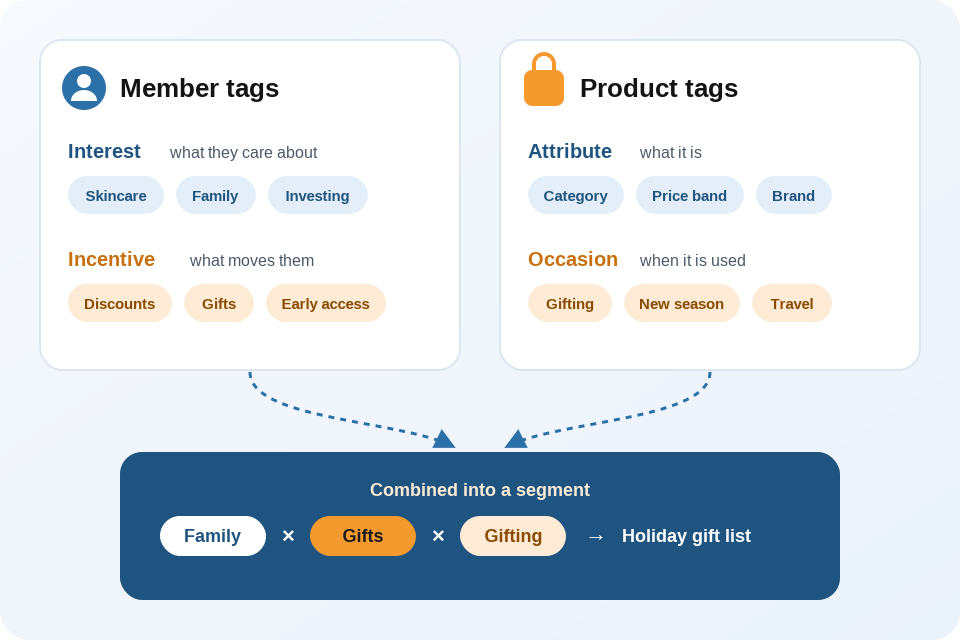
ESi consultants tag your members by interest and incentive and your products by attribute and occasion, then hand you segments you can use right away.
What marketing teams tell us
Member data keeps growing, but you can't use it
-
Every message goes to everyone
Emails, texts and LINE pushes go to all members. Sending costs keep rising while opens and conversions keep falling.
-
No idea who cares about what
Member records stop at name, phone and birthday. You can't tell who waits for launches, who only shows up for sales, or who needs a discount.
-
One member, scattered across systems
Your website, store POS, LINE and app each keep their own member records. The same person looks like a different customer in each, so you never see the full picture or know what to say to them.
-
Considering a CDP, unsure what it solves
Management asks about ROI, but the team has never really looked at its members, so it's hard to say where a CDP should start.
Combine tags into campaign lists
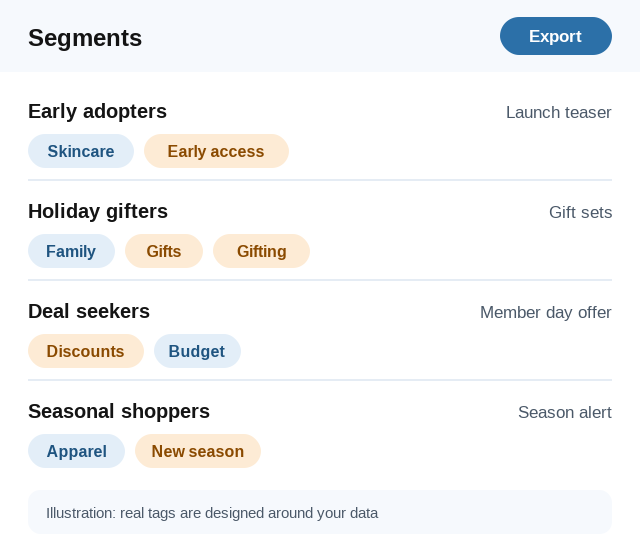
With tags, segmenting no longer runs on gut feel. Marketers combine tags for each campaign goal; "family × gifts × gifting", for example, is a list for the holiday season.
-
Stop sending one message to everyone
Segment by interest and incentive so messages go to the people likelier to respond, and sending costs stay under control.
-
Offers go to the right people
Discounts for those who respond to discounts, early access for those who want what's new, with no store-wide markdowns.
-
Campaign plans with a basis
Occasion tags tell you which products to push for a season or holiday, and member tags tell you whom to push them to.
What you get
What you have when the project ends
Not a report that sits on a shelf, but tags and lists the marketing team can use the next day.
-
Member data review
Member, sales, product and engagement data reviewed, showing which fields are usable now and which need filling.
-
Tag framework
Member and product tags designed around your categories and goals, with a definition and tagging rule for each.
-
Member profiles
The size, spending and engagement of each segment, so you see your members clearly for the first time.
-
Ready-to-use segments
Lists built for your marketing goals, ready to import into your email, text, LINE or ad tools.
Two ways to start
Not sure about a CDP yet? Start here
-
On its own: know your members first
Not sure you need a CDP? Analyse and tag the data you already have, get segments and run real campaigns, then decide whether a CDP is worth it.
-
Before a CDP: settle the tags first
Already decided on a CDP? Settle the tag framework and segment logic before launch. The CDP picks them up, and tags and lists then update with your data.

How we work
We define tags with your team
Tags only work if they fit your categories and the way you sell. We confirm each stage with your marketing team, and suggest next campaigns once the lists are delivered.
30-min online call
Your member base, your data sources and the marketing problem you most want to solve.
Data review
Member, sales, product and engagement data reviewed for usable fields and data quality.
Tag design and tagging
Member and product tags defined with your team, then applied by rule.
Segments and profiles
Segments and member profiles delivered, with suggested next campaigns and CDP plans.
- FoundedStarted with enterprise applications, now focused on MarTech
- 2006
- ConsultantsCDP, SharePoint, Dynamics 365, Sitecore, Adobe and more
- 170+
- Clients to dateServed across all of our solutions
- 200+
- Vendor partnersMicrosoft, Sitecore, Adobe, LINE, Google, Optimizely
- 6
Can we do this without a CDP?
Yes. The service runs on its own with your existing member, sales and product data; if you add a CDP later, the tag framework and segment logic carry over.
What data do we need?
Member, sales and product data are the base; website, app or LINE engagement data makes the tags richer. We confirm the scope in the consultation.
How is member data protected?
ESi is ISO 27001 certified company-wide and reassessed every year. How data is transferred, where it is stored and how it may be used are agreed before the project starts.
How do the lists stay up to date?
You can import the lists into your current tools straight away. Interests and incentives change over time; keeping tags and lists updated automatically is the job a CDP takes over.
Know your members first, then decide what's next
Start with one member data analysis, get tags and segments, then decide whether to bring in a CDP.
Leave your details and a consultant will be in touch soon
Leave your contact details and one of our consultants will get back to you shortly.
- Phone: +886-2-2515-5633
- Fax: +886-2-2515-6535
- Email: sales@esi-tech.net